Bespoke Programming and App Development: The Complete Buyer’s Guide
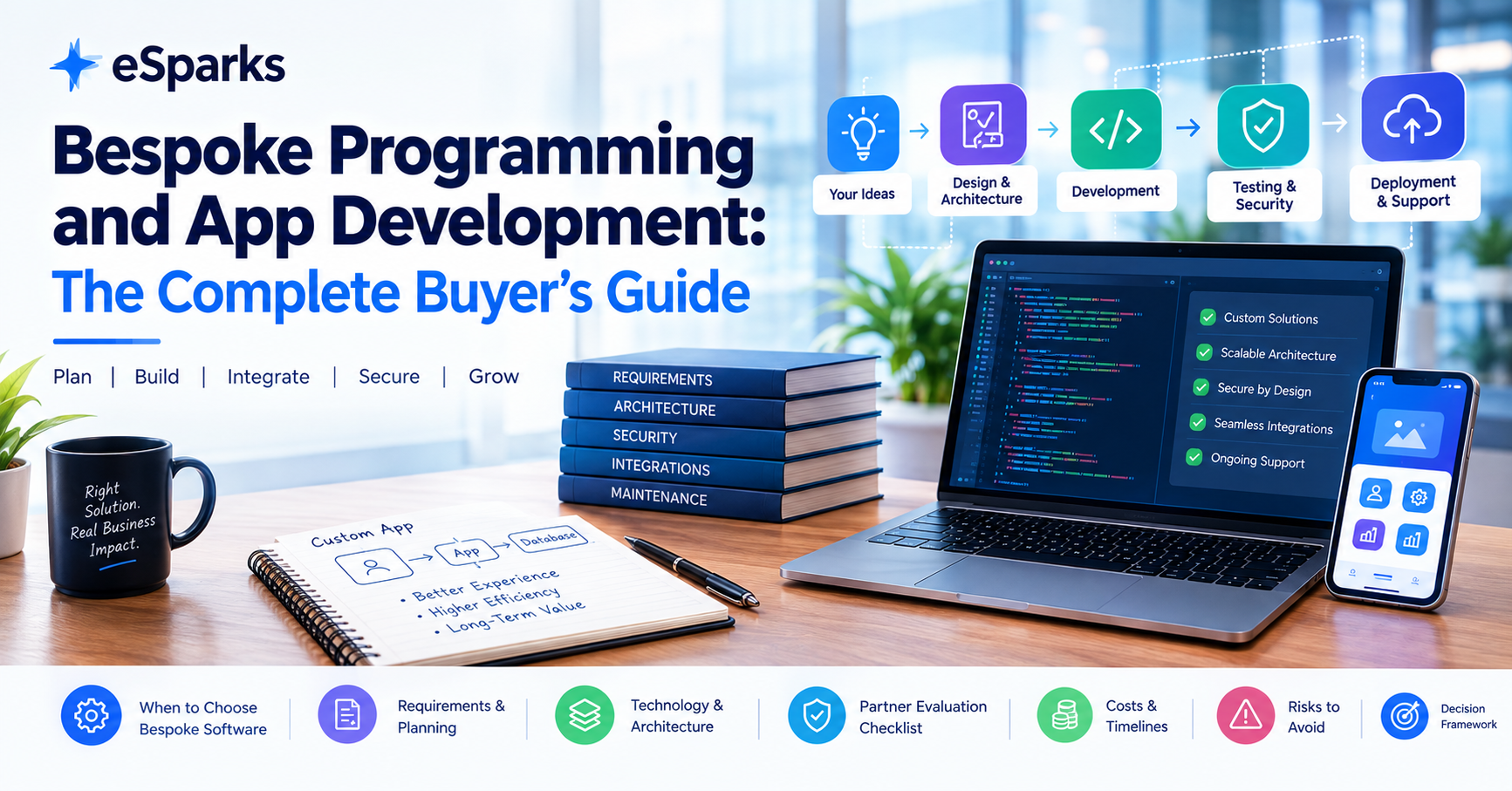
Bespoke programming and app development means creating software around your exact business processes, users, integrations, security requirements, and operational needs rather than forcing your organization to adapt to a generic product.
For many businesses, off-the-shelf SaaS platforms are the right starting point. They can be quick to deploy, relatively predictable in cost, and suitable for common business functions. But as workflows become more specialized, integrations become deeper, or security and compliance requirements become stricter, packaged software can create limitations that are difficult or expensive to overcome.
That is where bespoke software development becomes worth considering.
A well-designed custom application can connect fragmented systems, automate manual processes, improve visibility, support unique customer experiences, and give a business greater control over how its technology evolves.
But custom development also introduces responsibility. The business must make decisions about architecture, security, integrations, ownership, maintenance, budget, and long-term support.
This guide explains how to approach bespoke programming and app development from a buyer's perspective, including when it makes sense, what to define before development begins, how to evaluate a software partner, typical timelines and cost drivers, and how to reduce delivery risk.
What Is Bespoke Programming and App Development?
Bespoke programming and app development is the process of building software specifically for an organization's requirements.
Instead of purchasing a standard application and adapting internal processes around it, the development team designs the software around the organization's actual workflows.
This can include:
Custom web applications
Mobile applications
Customer portals
Partner portals
Internal business platforms
Workflow automation systems
Industry-specific applications
Operational dashboards
Integration platforms
Data management systems
AI-enabled business applications
Legacy system extensions
The important distinction is not simply that the software contains custom features.
The bigger difference is that the software architecture, workflows, permissions, integrations, and user experience are designed around the business itself.
The current eSparks guide highlights bespoke development as particularly valuable when workflows, integrations, security requirements, or competitive differentiation do not fit comfortably within off-the-shelf products.
Why Businesses Consider Bespoke Software
Many companies initially explore SaaS products, low-code platforms, plugins, or existing enterprise applications because these options appear faster and cheaper.
Sometimes they are.
However, problems can emerge when a business has processes that are significantly different from standard industry workflows.
For example, a distributor may need one platform to coordinate:
Sales
Customer-specific pricing
Inventory
Returns
Engineer scheduling
Customer approvals
After-sales support
Reporting
A generic CRM might handle leads and customer records effectively but struggle to represent the entire operational process.
The organization may then start adding spreadsheets, plugins, manual exports, custom scripts, and separate reporting systems.
Eventually, the company has not eliminated complexity. It has simply moved the complexity around.
Bespoke development can address this process mismatch by bringing important workflows into a system designed around how the organization actually operates.
Common signs that a business may need custom software
Some common warning signs include:
Employees maintain spreadsheets alongside core business systems.
Teams repeatedly copy information between applications.
Important processes depend on manual approvals.
Reports require manual data preparation.
Existing software cannot support required permissions.
Critical systems do not integrate properly.
Customers need a specialized portal or experience.
Compliance requirements exceed the capabilities of packaged software.
Business processes are becoming too complex for disconnected tools.
A unique workflow is becoming a competitive differentiator.
These problems can create operational drag that is difficult to see on a software invoice.
A company may believe it is saving money by avoiding custom development while spending significant amounts of employee time working around limitations.
When Should You Choose Bespoke Development?
Bespoke software is not automatically better than SaaS.
The decision should begin with the business problem.
A useful question is:
Can existing software support the required process without creating unacceptable compromises in cost, security, integration, usability, or scalability?
If the answer is yes, an existing product may be sufficient.
If the answer is no, bespoke development becomes more compelling.
Bespoke development can be appropriate when you need:
1. Specialized workflows
Your business operates differently from the standard process supported by commercial software.
2. Deep integrations
The application must connect with ERP, CRM, payment, logistics, accounting, legacy, or custom systems.
3. Advanced permissions
Different users require highly specific access, approval, or authorization rules.
4. Strong security controls
The business requires specific encryption, audit logging, retention, authentication, or data-management controls.
5. Unique customer experiences
Your competitive advantage depends partly on delivering an experience that generic platforms cannot easily reproduce.
6. Greater operational automation
The organization wants to eliminate repetitive data entry, manual approvals, reconciliation, or reporting.
7. Long-term scalability
The application is expected to become an important business platform rather than a temporary departmental tool.
What Should You Define Before Starting Development?
One of the biggest mistakes in software projects is discussing technology before defining the actual business problem.
Before discussing React, .NET, Node.js, AWS, Azure, mobile frameworks, databases, or AI, define what the software needs to accomplish.
The eSparks guide recommends establishing six practical areas before development begins.
1. Define the Core Users
Identify exactly who will use the application.
Users could include:
Internal employees
Customers
Partners
Suppliers
Administrators
Field teams
Managers
External contractors
Different users often require different workflows and permission levels.
2. Map Critical Workflows
Document the processes the software must support.
Examples include:
Customer onboarding
Quotation
Ordering
Approval
Fulfilment
Reporting
Support
Scheduling
Document management
Payments
Do not simply list features.
Describe how work actually moves from one step to another.
3. Identify Required Integrations
List every system that needs to exchange data with the new application.
Examples can include:
Microsoft Dynamics
Salesforce
SAP
HubSpot
Stripe
Xero
NetSuite
Custom APIs
SFTP feeds
Integration requirements can have a major impact on both timeline and budget.
4. Define Security and Compliance Requirements
Determine how sensitive information will be handled.
Consider:
Authentication
Authorization
Encryption
Audit logs
Data retention
Access controls
Data residency
Regulatory requirements
The requirements should be established before architecture decisions are finalized.
5. Define Non-Functional Requirements
Features are only part of a software project.
You should also define requirements such as:
Performance
Availability
Scalability
Offline operation
Accessibility
Multilingual support
Browser compatibility
Device compatibility
Backup and recovery
6. Define Success Criteria
Finally, determine how success will be measured.
For example:
Reduce processing time by a measurable amount.
Reduce manual data entry.
Improve reporting accuracy.
Reduce customer response time.
Increase operational visibility.
Improve release frequency.
Strengthen governance.
This gives the project a business objective rather than simply a list of technical features.
MVP: Start With the Workflow That Creates Value
Custom projects often become expensive because every requested feature is treated as essential.
An MVP should not mean an unfinished product.
Instead, it should represent the minimum production-ready workflow capable of creating measurable business value.
For example, a customer portal might initially include:
Secure authentication
Account information
Document access
Support requests
Advanced analytics, automation, and additional integrations can then be introduced in later phases.
This approach allows the business to validate the core workflow before committing the entire budget to a large platform.
Choosing the Right Technology Stack
There is no universally perfect technology stack.
Architecture should be selected according to the application's:
Complexity
Transaction volume
Security requirements
Compliance requirements
Team capabilities
Expected lifespan
Integration requirements
Scalability needs
A credible development partner should explain why a particular technology is appropriate rather than simply recommending the stack they use for every project.
Common Web Technologies
Depending on requirements, a web application might use:
React
Next.js
Angular
Vue
For backend development, common choices include:
.NET
Node.js
Java
Python
PHP/Laravel
Mobile Development
For mobile applications, native development with Swift or Kotlin can be appropriate for performance-heavy or hardware-dependent applications.
Cross-platform frameworks such as Flutter and React Native can be useful for business applications where sharing code across platforms provides operational benefits.
Databases
Common relational databases include:
PostgreSQL
SQL Server
MySQL
Additional technologies such as Redis, Elasticsearch, or MongoDB can support caching, search, or document-oriented workloads where appropriate.
Cloud and Infrastructure Matter Too
Application code is only one part of a production system.
A reliable architecture also needs to consider:
Hosting
CI/CD
Infrastructure as code
Secrets management
Backups
Monitoring
Logging
Disaster recovery
Deployment
Rollback
Cloud environments may use platforms such as:
AWS
Microsoft Azure
Google Cloud
Depending on requirements, infrastructure may include containers, Kubernetes, serverless services, managed databases, object storage, and CDN services.
A supplier that talks extensively about application features but cannot clearly explain deployment, monitoring, rollback, and incident response deserves additional scrutiny.
Example Architecture for a Business Platform
For a medium-complexity business application, a possible architecture could include:
Frontend: React or Next.js
API: .NET or Node.js
Database: PostgreSQL or SQL Server
Hosting: Azure App Service, AKS, or AWS ECS
CI/CD: GitHub Actions, GitLab CI, or Azure DevOps
Authentication: Azure AD, Auth0, Okta, or Keycloak
Observability: Datadog, Grafana, Prometheus, Application Insights, or CloudWatch
This is an example rather than a universal recommendation. The actual architecture should be selected after understanding the project's requirements.
How to Evaluate a Bespoke Software Development Partner
Choosing the right development partner is one of the most important decisions in a custom software project.
A strong supplier should be able to discuss both business strategy and technical implementation.
Instead of focusing only on portfolio screenshots or attractive demos, ask questions that reveal how the team manages complexity.
Questions to Ask
Discovery and Planning
Ask:
How do you convert discovery findings into a technical roadmap?
How are requirements prioritized?
Who is responsible for validating assumptions?
Scope Management
Ask:
How do you handle changing requirements?
How do you prevent scope from expanding without budget visibility?
How are change requests approved?
Testing
Ask:
What is your approach to unit testing?
How do you handle integration testing?
Do you perform end-to-end testing?
How do you test performance?
How is security testing handled?
Integration
Ask:
How will the application integrate with existing systems?
Who owns API definitions?
How are integration failures handled?
How are third-party dependencies monitored?
Security
Ask:
How do you manage authentication?
How is authorization implemented?
How is sensitive data encrypted?
Are audit logs included?
How are secrets managed?
Documentation
Ask:
What technical documentation will be delivered?
Will architecture diagrams be provided?
Are deployment procedures documented?
Is there a handover process?
Post-Launch
Ask:
What happens after launch?
Is ongoing support available?
How are production bugs handled?
What are the SLA options?
How are patches and enhancements managed?
These questions help move the conversation beyond sales language and toward delivery reality.
Ask for Evidence, Not Just Promises
A credible partner should be able to demonstrate how it works.
Useful artifacts may include:
Architecture diagrams
Sample user stories
Acceptance criteria
Release processes
Runbooks
Support workflows
Testing strategies
Code quality practices
Documentation examples
Good engineering teams commonly use:
Source control
Pull requests
Coding standards
Peer review
Static analysis
Issue tracking
Automated testing
CI/CD
Documentation and ownership should be established early because maintainability becomes increasingly important after launch.
Choosing the Right Commercial Model
The commercial structure should match project complexity.
Fixed Price
Fixed-price development can work well when:
Requirements are clear.
Scope is well defined.
The project is relatively short.
Technical uncertainty is limited.
However, a shallow discovery phase can make fixed pricing difficult because unknown requirements eventually become change requests.
Time and Materials
Time-and-materials models can be more flexible for complex projects.
They can work well when requirements are expected to evolve, provided the supplier provides:
Velocity reporting
Budget tracking
Transparent timesheets
Regular demonstrations
Governance
Clear prioritization
Discovery First
Another option is to start with a dedicated discovery phase.
Discovery can clarify:
Requirements
User journeys
Architecture
Integrations
Risks
MVP scope
Delivery estimates
The organization can then move into phased development with a stronger understanding of the technical and commercial landscape.
Bespoke App Development Costs
There is no single price for custom software.
The cost depends heavily on:
Scope
Integration complexity
Data migration
Security
Compliance
Number of user roles
Mobile requirements
Reporting
Performance requirements
Infrastructure
Support expectations
The current eSparks guide gives broad planning ranges rather than a single universal price. A focused business MVP may take around 8–16 weeks, while a more substantial platform can take roughly 4–9 months. Larger enterprise programmes can take longer, especially when compliance, procurement, multiple systems, and staged deployment are involved.
Typical budget categories described in the guide include:
Smaller MVPs or workflow automation applications: often tens of thousands of pounds
Mid-sized operational platforms: often high tens to low hundreds of thousands
Larger multi-product or regulated systems: potentially substantially higher once integrations, support, and governance are included
These should be treated as planning ranges rather than quotations.
What Actually Drives Development Cost?
Technology choice is only one part of the budget.
1. Integrations
Every additional external system can introduce:
API development
Authentication
Data mapping
Error handling
Rate limits
Testing
Monitoring
2. Data Migration
Moving existing data can involve:
Data cleansing
Duplicate removal
Transformation
Validation
Historical records
Migration testing
3. Permissions and Approvals
Complex role-based access and multi-stage approval workflows can significantly increase implementation effort.
4. Mobile and Offline Requirements
Offline operation often requires additional synchronization logic, conflict handling, local storage, and testing.
5. Compliance and Security
Penetration testing, audit requirements, encryption, access controls, and compliance processes can add project effort.
6. Reporting and Analytics
Dashboards may look simple but can require significant backend work when reports depend on complex business logic or multiple data sources.
7. Scalability and Resilience
Multi-region deployments, high availability, performance requirements, disaster recovery, and resilience can increase infrastructure complexity.
Don't Confuse Build Cost With Ownership Cost
The initial development invoice is not the full cost of software ownership.
A realistic budget should also consider:
Hosting
Monitoring
Third-party licenses
Security reviews
Patching
Support
Backups
Infrastructure
Future development
Technical maintenance
A low-cost application can become expensive if it is poorly documented, difficult to deploy, difficult to maintain, or dependent on fragile integrations.
The goal should therefore be to evaluate total cost of ownership, not just the initial development quotation.
Common Bespoke Software Project Risks
Many software projects do not fail because the programming language or cloud provider was wrong.
The underlying problems are often related to planning, ownership, scope, and risk management.
1. Unclear Requirements
If stakeholders cannot agree on what the application needs to accomplish, development becomes an ongoing discovery exercise.
2. Weak Product Ownership
Someone needs authority to make decisions about scope, priorities, and acceptance.
Without clear ownership, projects can become slow and inconsistent.
3. Underestimated Integrations
API documentation does not always reveal:
Edge cases
Rate limits
Authentication problems
Data-quality issues
Legacy behavior
Incomplete mappings
Integration validation should happen early.
4. Ignoring Non-Functional Requirements
Performance, security, logging, accessibility, backup, and disaster recovery should not be treated as final-stage extras.
Retrofitting these requirements can be more expensive than designing for them from the beginning.
5. No Post-Launch Plan
Software needs maintenance after launch.
Before development starts, determine:
Who owns the product?
Who handles incidents?
Who manages updates?
Who fixes bugs?
Who manages security patches?
Who approves enhancements?
How to Reduce Delivery Risk
A practical custom software project should include several fundamentals.
Discovery
The discovery phase should cover:
Business processes
Technical constraints
Existing systems
Integration requirements
Security
Users
Risks
Acceptance Criteria
Every important feature should have clear criteria describing when it is considered complete.
Separate Environments
Use appropriate environments for:
Development
Testing
Production
Regular Demonstrations
Regular demos help stakeholders verify actual progress rather than relying solely on status reports.
Comprehensive Testing
Testing should cover:
Normal workflows
Edge cases
Failure scenarios
Integrations
Security
Performance
Launch Planning
Before production release, confirm:
Data migration
Rollback
Monitoring
Backups
User access
Support
Documentation
What About AI Features?
Many businesses now want AI integrated into custom applications.
Potential use cases include:
AI assistants
Search
Summarization
Forecasting
Document processing
Knowledge retrieval
Workflow automation
However, AI should solve a defined business problem rather than being added simply because it is currently popular.
AI-enabled software introduces additional considerations such as:
Data boundaries
Model evaluation
Prompt management
Fallback behavior
Human review
Cost controls
Output validation
Security
The AI component should therefore be treated as part of the overall business workflow.
An 8-Step Framework for Deciding Whether to Build
If you are unsure whether bespoke development is justified, use a structured process.
Step 1: Define the Problem
Describe:
What is broken?
Who is affected?
What is the cost of the current process?
What happens if nothing changes?
Step 2: Map the Current Workflow
Document the complete process.
Include:
Manual work
Approvals
Duplicate data entry
Spreadsheets
Reporting gaps
Handoffs
Step 3: Identify Systems of Record
Determine where important data currently lives.
Map all integration points.
Step 4: Prioritize Requirements
Separate requirements into:
Must-have
Should-have
Later phase
This helps prevent the MVP from becoming an uncontrolled enterprise programme.
Step 5: Evaluate Existing Alternatives
Ask:
Can an existing SaaS product solve approximately 80% of the requirement without creating unacceptable compromises?
Also consider whether low-code tools could solve departmental workflows while leaving core systems unchanged.
Step 6: Assess Ownership and Risk
Determine:
Who owns the product?
Who approves scope?
Who manages vendors?
What support is required?
What security responsibilities exist?
Step 7: Request Discovery-Led Proposals
Ask shortlisted partners to provide:
Problem summary
Assumptions
Recommended architecture
Architecture rationale
Delivery phases
Indicative timeline
Team structure
Dependencies
Risks
Testing approach
Security approach
Deployment approach
Commercial model
Out-of-scope items
Step 8: Compare Total Value
Do not evaluate proposals solely by their initial price.
Consider:
Business fit
Technical quality
Security
Maintainability
Scalability
Support
Delivery transparency
Total ownership cost
A proposal that identifies hidden complexity early may reduce project risk even when its initial price is not the lowest.
Bespoke Software vs Off-the-Shelf: A Practical Comparison
| Factor | Off-the-Shelf | Bespoke |
|---|---|---|
| Initial deployment | Usually faster | Usually longer |
| Custom workflows | Limited by product | Designed around business |
| Integrations | Depends on available connectors | Can be purpose-built |
| User experience | Standardized | Fully customizable |
| Security controls | Product-dependent | Designed around requirements |
| Scalability | Vendor-dependent | Architecture can be tailored |
| Initial cost | Often lower | Usually higher |
| Long-term flexibility | Depends on vendor roadmap | Greater control |
| Maintenance | Mostly vendor-managed | Business/partner responsibility |
| Competitive differentiation | Usually limited | Potentially significant |
Neither option is automatically right.
The appropriate choice depends on the business's processes, risk profile, budget, strategic priorities, and long-term operating model.
Questions to Ask Before Signing a Development Contract
Before committing to a bespoke development project, confirm:
Product
What problem is the application solving?
Who are the primary users?
What is included in the MVP?
Technology
What architecture is proposed?
Why was this stack selected?
How will the application scale?
Security
How is authentication handled?
How is authorization implemented?
How is sensitive information protected?
Are audit logs included?
Integrations
Which systems are included?
Who owns API development?
How are failures handled?
Delivery
What are the project phases?
What are the acceptance criteria?
How frequently will demos occur?
Commercials
What is included?
What is excluded?
How are changes priced?
What happens if the timeline changes?
Ownership
Who owns the source code?
Who owns documentation?
How will credentials and infrastructure be handed over?
Support
What happens after launch?
What are the support hours?
Are SLAs available?
How are security patches handled?
Frequently Asked Questions
What is bespoke programming and app development?
Bespoke programming and app development means creating software specifically around an organization's workflows, users, integrations, security requirements, and operational needs. Unlike generic software, the system is designed around how the business operates.
When should a business choose bespoke software over SaaS?
A business should consider bespoke software when packaged products cannot adequately support critical workflows, integrations, security requirements, data controls, or competitive differentiators without significant compromise.
It can also make sense when employees depend heavily on manual workarounds, spreadsheets, fragmented reporting, or disconnected systems.
How long does bespoke app development take?
A focused MVP can take several weeks to a few months, while larger applications involving multiple integrations, reporting, mobile support, compliance, and complex workflows can take several months or longer. The actual timeline depends on scope, technical complexity, stakeholder availability, integration requirements, and testing.
How much does bespoke software cost?
There is no universal price.
The cost depends on application scope, integrations, data migration, security, compliance, user roles, reporting, mobile requirements, infrastructure, and support.
A focused MVP may fall into a tens-of-thousands budget range, while larger operational and enterprise platforms can move into significantly higher budgets.
How can I evaluate a software development company?
Look beyond portfolios and marketing claims.
Ask potential partners about:
Architecture
Testing
Security
Integrations
Documentation
Deployment
Monitoring
Support
Scope management
Ask for practical evidence such as architecture diagrams, delivery processes, anonymized documentation, testing approaches, and support workflows.
Should bespoke software always be built from scratch?
Not necessarily.
A custom application can use existing frameworks, cloud services, authentication providers, databases, APIs, and managed infrastructure.
The objective is not to reinvent every component. The objective is to create the right system for the business while controlling risk and long-term ownership costs.
Final Thoughts
Bespoke programming and app development should not begin with the question:
“Which technology should we use?”
It should begin with:
“What business problem are we solving, and what does the organization need the software to do?”
Once the workflow, users, integrations, security requirements, success criteria, and ownership model are clear, technology decisions become much easier.
The strongest bespoke software projects combine business understanding with disciplined engineering.
That means:
Clear requirements
Focused MVP scope
Appropriate architecture
Validated integrations
Strong security
Automated testing
Transparent delivery
Clear ownership
Documented systems
Reliable deployment
Post-launch support
A realistic total-cost-of-ownership plan
The goal is not simply to build another application.
The goal is to create software that fits the business, removes operational friction, supports growth, and remains maintainable as requirements evolve.
For organizations whose workflows, integrations, security needs, or competitive model cannot be served effectively by generic products, bespoke software can become a strategic business capability rather than just another IT expense.
Work With eSparks IT Solutions
Planning a bespoke web or mobile application?
eSparks IT Solutions helps businesses across the USA, UK, Canada, Australia, and the GCC plan, design, develop, and support custom digital solutions.
Explore mobile development services, review the portfolio, estimate your project cost, or speak with the team about your requirements.
Related services:
Mobile App Development
Web Application Development
UI/UX Design
Custom Software Development
Cloud Solutions
AI & Machine Learning
Software Integration
Related topics: #mobile-development #bespoke #programming #development
Work with eSparks IT Solutions
Planning a project around this? We help businesses across the USA, UK, Canada, Australia and the GCC ship it. Explore our Mobile Development services and portfolio, estimate your project cost, or book a free call.