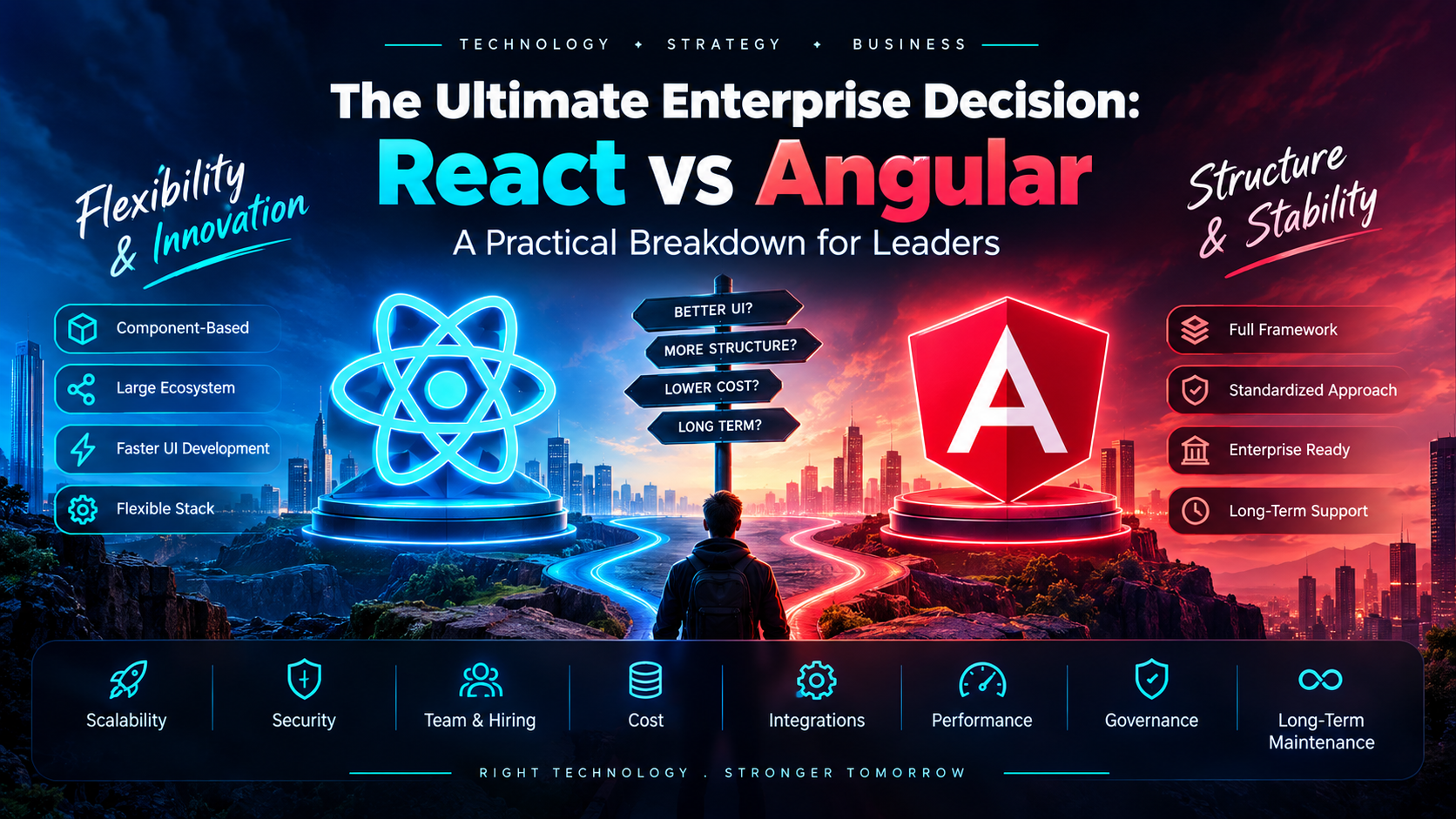
The Ultimate Enterprise Decision: React vs Angular — A Practical Breakdown for Leaders
Choosing a frontend technology for an enterprise application is not simply a developer preference. It is a business decision that can influence development speed, hiring, architecture, security, scalability, maintenance, and long-term costs.
React and Angular are both capable of powering large enterprise applications. The important question is not which one is universally better, but which one best fits your business goals, team capabilities, application complexity, governance requirements, and long-term roadmap.
React vs Angular: The Short Answer
If your organization prioritizes flexibility, rapid UI innovation, and a broad ecosystem, React can be an excellent choice.
If your organization prioritizes structure, standardization, and consistent development across large teams, Angular may be the better fit.
A simple way to think about the difference is:
React = Flexibility + Ecosystem + UI Innovation
Angular = Structure + Standardization + Enterprise Governance
Neither technology is automatically the right answer. The decision should be based on the application and the organization that will build and maintain it.
Why This Decision Matters Beyond the Frontend
Enterprise applications are rarely simple.
They can include:
Multiple user roles
Authentication and SSO
Complex dashboards
Approval workflows
Large data tables
Reporting
ERP integrations
CRM integrations
Payment systems
Notifications
Audit logs
Analytics
Multiple development teams
Continuous releases
The frontend framework can influence how teams build, test, maintain, and upgrade these systems.
For business leaders, the decision should therefore consider more than development speed.
Important factors include:
Architecture
Security
Developer availability
Team expertise
Scalability
Testing
Governance
Integrations
Performance
Maintenance
Total cost of ownership
The real question is:
Which technology reduces delivery risk while supporting the organization’s long-term roadmap?
What Is React?
React is a component-based JavaScript library used to build modern user interfaces.
One of its biggest strengths is flexibility.
React focuses primarily on the UI layer, allowing teams to choose additional technologies for:
Routing
State management
Data fetching
Forms
Testing
Build tooling
UI component systems
A modern enterprise React application may use technologies such as:
React
TypeScript
Next.js
Vite
React Router
TanStack Query
Redux Toolkit
Zustand
Playwright
Vitest
This flexibility gives organizations significant control over their technology stack.
However, flexibility also creates responsibility.
Without clear engineering standards, different teams may select different tools and patterns, eventually making the application harder to maintain.
What Is Angular?
Angular is a complete frontend framework designed for building large-scale web applications.
It provides many capabilities as part of the framework, including:
TypeScript
Routing
Forms
Dependency injection
HTTP tooling
Reactive programming
CLI tooling
Component architecture
Testing support
This makes Angular attractive to organizations that want a consistent development approach across multiple teams.
Instead of allowing every team to select its own architecture, an organization can establish common Angular conventions.
This can be especially useful for:
Enterprise systems
Internal business platforms
Workflow-heavy applications
Regulated environments
Multi-team projects
Long-term software programs
React vs Angular: The Core Difference
The biggest difference between React and Angular is flexibility versus structure.
React
React allows teams to build their own technology stack.
Teams can choose:
Routing
State management
API libraries
Form libraries
UI frameworks
Build tools
Application architecture
Angular
Angular provides a more complete and structured framework.
Many important application capabilities are already part of the Angular ecosystem.
This reduces the number of architectural decisions teams need to make.
A simple way to frame it:
React gives you a toolkit to design your enterprise approach.
Angular gives you a structured blueprint with fewer architectural decisions left open.
React vs Angular Comparison
FactorReactAngularTypeUI libraryFull frameworkFlexibilityVery highModerateStructureTeam-definedFramework-definedTypeScriptCommonly usedBuilt-in/defaultLearning curveEasier to startSteeperEcosystemVery largeStrong and integratedStandardizationRequires governanceStrong conventionsUI innovationExcellentExcellentEnterprise applicationsExcellentExcellentLarge teamsStrong with standardsVery strong
React for Enterprise Applications
React can be a strong choice for enterprises that need flexibility and rapid user-interface development.
It works particularly well for:
SaaS platforms
Customer portals
E-commerce applications
Analytics dashboards
Digital products
Internal applications
Partner portals
Administration systems
Customer-facing platforms
React’s component-based architecture makes it possible to build reusable UI components.
For example, an organization can create a shared design system containing:
Buttons
Forms
Tables
Navigation
Cards
Modals
Charts
Alerts
Notifications
These components can then be reused across multiple products.
This can improve consistency and reduce duplicated development work.
Angular for Enterprise Applications
Angular can be particularly attractive for organizations that prioritize structure and consistency.
It can be a strong fit for:
ERP systems
Banking applications
Healthcare platforms
Government systems
Enterprise administration portals
Internal business applications
Procurement platforms
Workflow management systems
Complex operational applications
Angular’s conventions can help multiple development teams work within a shared architecture.
Teams can establish consistent patterns for:
Authentication
Billing
Procurement
Reporting
Customer management
Inventory
Administration
This can reduce architectural drift as the application grows.
Architecture and Scalability
Enterprise applications rarely remain small.
As they grow, they typically gain:
More modules
More users
More roles
More integrations
More workflows
More data
More reports
More security requirements
Framework selection should therefore be evaluated at the architecture level rather than through a simple demo application.
React Scalability
React can scale extremely well when supported by strong engineering practices.
A mature enterprise React architecture may include:
TypeScript
Shared UI components
Design systems
Clear domain boundaries
API abstraction
State-management standards
Automated testing
Code-quality rules
CI/CD
Performance budgets
React’s flexibility becomes an advantage when the organization has experienced engineering teams.
However, flexibility without governance can create problems.
Different teams might select different state-management libraries, API patterns, or component approaches.
Over time, this can increase technical debt.
Angular Scalability
Angular provides stronger architectural guidance from the beginning.
Its ecosystem supports patterns involving:
Components
Services
Dependency injection
Guards
Forms
Routing
Reactive programming
CLI-based development
This can make it easier for large teams to follow common patterns.
For organizations with many developers working on one application, this consistency can become a significant advantage.
Micro-Frontends: React vs Angular
Large organizations sometimes use micro-frontends to allow different teams or business units to develop parts of a larger application independently.
Both React and Angular can support micro-frontend architectures.
React may be attractive when business units need greater autonomy and faster release cycles.
Angular can work well when centralized governance and consistent standards are more important.
However, micro-frontends should not be adopted simply because they are popular.
They introduce additional complexity around:
Deployment
Versioning
Shared dependencies
Authentication
Communication
Testing
Monitoring
For many organizations, a well-structured modular application can be simpler and more cost-effective.
Performance: React vs Angular
Performance is often misunderstood.
It is not accurate to assume that one framework will automatically make an enterprise application faster.
Real-world performance depends on:
Application architecture
API performance
Database performance
Bundle size
Rendering strategy
State management
Network conditions
Caching
Code splitting
Data-fetching patterns
Both React and Angular can deliver high-performance enterprise applications when implemented correctly.
React Performance
React applications can improve performance through:
Code splitting
Lazy loading
Efficient component design
Memoization where appropriate
Virtualized lists
Optimized data fetching
Server-side rendering where appropriate
Angular Performance
Angular applications can benefit from:
Ahead-of-Time compilation
Lazy-loaded routes
Efficient change detection
Proper RxJS usage
Code splitting
Component optimization
The important lesson is:
Good architecture matters more than simply choosing React or Angular.
Security: React vs Angular
Security should never be treated as an afterthought in enterprise software.
Applications may process:
Customer information
Financial data
Employee information
Business documents
Internal records
Authentication information
Sensitive transactions
Both React and Angular can support secure enterprise applications.
Important security capabilities include:
OAuth 2.0
OpenID Connect
SSO
MFA
Role-based access control
Least privilege
Secure token management
Audit logging
Dependency scanning
Secrets management
Secure APIs
Content Security Policy
Angular provides more built-in conventions and protections.
React provides more flexibility, which means teams need to establish secure development patterns themselves.
This does not mean Angular is automatically more secure.
Security ultimately depends on:
Architecture
Implementation
Development practices
Testing
Infrastructure
Monitoring
Operational processes
A mature enterprise setup should include automated security testing, dependency scanning, secure coding standards, access controls, audit logging, and appropriate performance monitoring.
Enterprise Authentication and SSO
Modern enterprise applications frequently require centralized authentication.
Common technologies include:
OAuth 2.0
OpenID Connect
SAML
Single Sign-On
Multi-Factor Authentication
Organizations may integrate with platforms such as:
Microsoft Entra ID
Okta
Auth0
Keycloak
Both React and Angular can integrate with these systems.
The important questions are:
How will authentication work?
How will sessions be managed?
How will roles be enforced?
How will privileged actions be audited?
How will MFA be handled?
How will tokens be protected?
These architectural decisions matter more than the frontend framework itself.
React vs Angular for Large Teams
Team size is an important factor.
React
React can work extremely well when teams need autonomy.
It is a strong choice when:
Teams already have React expertise
UX iteration is important
Different products have different needs
Developers need technology flexibility
The organization has strong engineering governance
The main risk is inconsistency.
Without governance, teams may select different tools and patterns.
Angular
Angular can be attractive when many teams need to follow the same structure.
It can help organizations standardize:
Project structure
Services
Routing
Forms
Dependency injection
Coding patterns
Testing approaches
For large enterprise programs, this can reduce architectural drift.
Cost: Which Is Cheaper?
This is one of the most common questions business leaders ask.
The honest answer is:
The framework itself is rarely the biggest cost factor.
Actual costs are influenced by:
Application complexity
Number of features
Integration requirements
Data migration
UX/UI requirements
Security
Testing
DevOps
Team experience
Maintenance
Support
Change requests
React may allow faster initial UI development for teams with strong React experience.
Angular may require more initial learning and setup but can provide consistency for large organizations.
The correct comparison is:
Total cost of ownership — not just initial development cost.
Total Cost of Ownership
Enterprise leaders should consider the cost of the application over several years.
Consider:
Development
Maintenance
Developer hiring
Framework upgrades
Dependency updates
Testing
Monitoring
Security
Documentation
Training
Production support
A cheaper first release that becomes difficult to maintain can become significantly more expensive later.
The best framework is therefore the one your organization can realistically support over the long term.
React vs Angular: Hiring and Team Skills
Technology decisions should consider the people who will maintain the application.
Ask:
Do we already have React developers?
Do we already have Angular developers?
Which talent is easier to hire?
Will an external vendor maintain the system?
Who owns the application after launch?
Can developers be trained?
Will the team still be available in three or five years?
A technically excellent framework can still become a poor business decision if the organization cannot maintain it.
Team capability should therefore be one of the highest-weighted criteria.
A Practical Decision Framework for Business Leaders
Instead of choosing React or Angular based on popularity, use a structured process.
Step 1: Define the Application
Determine whether the application is:
Customer-facing
Internal
SaaS
Workflow-heavy
Data-heavy
Mobile-friendly
Multi-tenant
Integration-heavy
A customer-facing product may prioritize UX flexibility.
A process-heavy enterprise system may prioritize structure and consistency.
Step 2: Evaluate Your Team
Review:
Existing expertise
Hiring availability
Vendor capabilities
Training requirements
Long-term ownership
Do not select a framework your organization cannot realistically maintain.
Step 3: Map Integrations
Identify systems such as:
ERP
CRM
IAM
Payment gateways
Analytics
CMS
Legacy APIs
Data platforms
Frontend architecture should be designed alongside backend and integration architecture.
Step 4: Define Governance Requirements
Ask:
How many developers will work on the project?
How many teams are involved?
Will external vendors contribute?
Are strict coding standards required?
Is centralized governance important?
If governance is critical, Angular’s structure may be attractive.
If flexibility is more important, React may be a better fit.
Step 5: Build a Real Proof of Concept
Do not evaluate frameworks using a simple counter application.
Build a realistic feature containing:
Authentication
Role-based navigation
Complex form
Data table
API integration
Error handling
Automated tests
Then evaluate:
Developer experience
Code organization
Performance
Maintainability
Testing
Security
Ease of onboarding another developer
A real proof of concept provides a much better basis for an enterprise decision.
Step 6: Score Both Options
Evaluate React and Angular against:
Team expertise
Hiring availability
Development speed
Long-term maintainability
Security
Integration complexity
Governance
UI flexibility
Testing
Observability
Upgrade effort
Total cost
The purpose is not to create a perfect mathematical answer.
It is to prevent personal preferences from controlling an enterprise technology decision.
Common React Mistakes
React’s flexibility can become a problem if organizations do not establish standards.
Common mistakes include:
Choosing React only because it is popular
No architecture guidelines
Too many libraries
Multiple state-management approaches
Duplicated API logic
Inconsistent coding patterns
No shared component system
Weak testing
Poor documentation
How to avoid them
Create an approved enterprise React stack.
For example:
React + TypeScript + approved routing + approved state/data tools + shared design system + automated testing.
The exact tools can vary, but the organization should establish clear standards.
Common Angular Mistakes
Angular’s structure can also be misused.
Common mistakes include:
Ignoring Angular conventions
Poor RxJS practices
Unorganized services
Weak domain boundaries
Bypassing framework patterns
Poor testing
Overcomplicating components
How to avoid them
Use Angular’s architecture rather than constantly fighting against it.
Establish:
Coding standards
Component conventions
Service patterns
RxJS guidelines
Testing requirements
Upgrade policies
Don’t Forget the Backend
One of the biggest mistakes organizations make is treating frontend technology as the entire architecture.
React or Angular cannot fix:
Poor APIs
Slow databases
Weak authentication
Poor authorization
Poor DevOps
Missing monitoring
Weak infrastructure
Poor data architecture
Enterprise success requires coordination between:
Frontend + Backend + Database + Cloud + Security + QA + DevOps
A high-performance React dashboard will still feel slow if the backend API takes several seconds to return data.
Similarly, an excellent Angular application cannot compensate for poor authorization logic.
When Should You Choose React?
React may be the stronger choice when:
Flexibility is important
UX innovation is a priority
Fast UI iteration is required
Your team already knows React
You want a broad ecosystem
Multiple products require different approaches
Micro-frontends are part of your strategy
Your organization has strong engineering governance
React is particularly attractive when the business wants to experiment and iterate quickly.
When Should You Choose Angular?
Angular may be the stronger choice when:
Standardization is important
Multiple development teams are involved
Application workflows are complex
Governance is a major priority
Consistent architecture is required
The application is expected to operate for many years
The organization prefers an integrated framework
Teams benefit from predefined conventions
Angular can be particularly valuable when predictability matters more than maximum tooling freedom.
The Real Enterprise Decision
The biggest mistake is asking:
“Which one is better?”
Instead ask:
“Which one fits our organization better?”
A startup building a highly interactive customer platform may prioritize React’s flexibility.
A large enterprise building a complex internal workflow platform may prefer Angular’s structure.
But there is no universal rule.
An experienced engineering team can build excellent enterprise applications with either technology.
The architecture, development standards, security practices, testing strategy, and operational discipline matter enormously.
Final Checklist Before Choosing
Before committing to React or Angular, answer these questions.
Business
What problem are we solving?
Who are the users?
How quickly must we launch?
How long will the system operate?
Technical
What integrations are required?
How complex is the UI?
How much data will the application handle?
Do we need advanced rendering?
Do we need micro-frontends?
Team
What skills already exist?
How easy is hiring?
Who owns the application after launch?
Will external vendors contribute?
Security
Do we need SSO?
Do we need MFA?
What data is sensitive?
What audit requirements exist?
What compliance requirements apply?
Operations
How will deployments work?
Who handles upgrades?
What is the testing strategy?
How will performance be monitored?
What is the rollback process?
Financial
What is the initial development budget?
What will maintenance cost?
What will upgrades cost?
What is the expected three-to-five-year total cost?
Frequently Asked Questions
Which is better for large business systems: React or Angular?
Both can support large business systems effectively.
React is generally attractive when flexibility and fast UI iteration are priorities, while Angular is often attractive when strong structure, conventions, and standardization across teams are important.
Is Angular more secure than React?
Not automatically.
Angular provides built-in patterns and protections that can help teams avoid certain common mistakes. React can also be highly secure when organizations implement strong authentication, authorization, dependency management, secure API communication, and testing practices.
Does React cost less to build than Angular?
Not necessarily.
React can speed up initial UI development, but inconsistent libraries and weak standards can increase long-term maintenance costs.
Angular may require more upfront onboarding, but its structured approach can reduce governance and maintenance effort in larger organizations.
Which has a better ecosystem?
React provides a very broad ecosystem and significant flexibility.
Angular provides a more integrated framework with many capabilities and conventions already established.
The better ecosystem is the one that matches your organization’s requirements.
Which is easier to learn?
React is generally easier to start with because its core concept is focused on UI components.
However, enterprise React development requires learning additional tools and architectural patterns.
Angular has a steeper initial learning curve but provides a more structured development environment.
Can React handle enterprise applications?
Yes.
React can power large enterprise applications when supported by strong architecture, TypeScript, testing, design systems, security practices, CI/CD, and engineering governance.
Can Angular handle modern UI applications?
Yes.
Angular can support modern, highly interactive applications and complex enterprise user experiences.
The quality of the final product depends heavily on architecture and implementation.
Conclusion
React and Angular are both capable enterprise technologies.
The right decision should not be based on hype, popularity, or personal developer preference.
Instead, evaluate:
Team + Architecture + Security + Governance + Integrations + Performance + Cost + Long-Term Maintenance
Choose React when flexibility, UI innovation, and ecosystem breadth are strategic advantages.
Choose Angular when structure, standardization, and consistency across large teams are more important.
Most importantly, remember that the framework is only one part of the solution.
A successful enterprise application requires:
Good architecture + secure engineering + reliable APIs + automated testing + CI/CD + observability + strong governance
The ultimate enterprise decision is therefore not simply React vs Angular.
It is about choosing the technology that your organization can build, secure, scale, maintain, and evolve for years to come.
Make the framework serve the business — not the other way around.
Work with eSparks IT Solutions
Planning a project around this? We help businesses across the USA, UK, Canada, Australia and the GCC ship it. See a related project: Esparks Edu — School Management ERP. Explore our Web Development services and portfolio, estimate your project cost, or book a free call.